
Social media turns everything into a trial. Lives are reduced to details and judged by strangers who never face the fallout. Context comes later, if it comes at all.
Once someone is “cancelled,” the benefit of the doubt disappears. Explanations sound like excuses. Silence looks guilty.
The Corner Studio’s People v. Dela Cruz makes its intention explicit from the start. The first scene projects a stream of TikTok videos about the case. They are shallow, context-less content meant to be consumed and shared. The urgency of the issue is buried under trends and clout chasing.
The play isn’t a realistic legal drama. It is a social commentary on how judgment is shaped, simplified, and distorted.
Public judgment doesn’t wait for the facts to settle. It takes shape in bits and pieces, and spreads before anyone has to deal with what it actually does to the people involved.
Inspired Premise
The play is a one-act satire that starts with a simple idea. What if the Philippines had a jury system?
The first case the jury gets is about an alleged addict who killed a police officer during a drug raid. While I was watching, I kept thinking about 12 Angry Men (1957). The setup is almost the same. There’s a small group of jurors in one room, arguing over one case, until they all agree on a final verdict.
This is also director Eldrin Veloso’s second production, which probably explains why the structure feels so sure of itself.
But the play doesn’t try to copy the classic film beat for beat. Instead, it transforms the setup into an allegory of what a trial by social media looks like. It’s messy, loud, emotionally charged, and driven as much by bias as by facts.
The Jury as Social Archetypes

Each juror feels like someone you might have already encountered, either online or in real life.
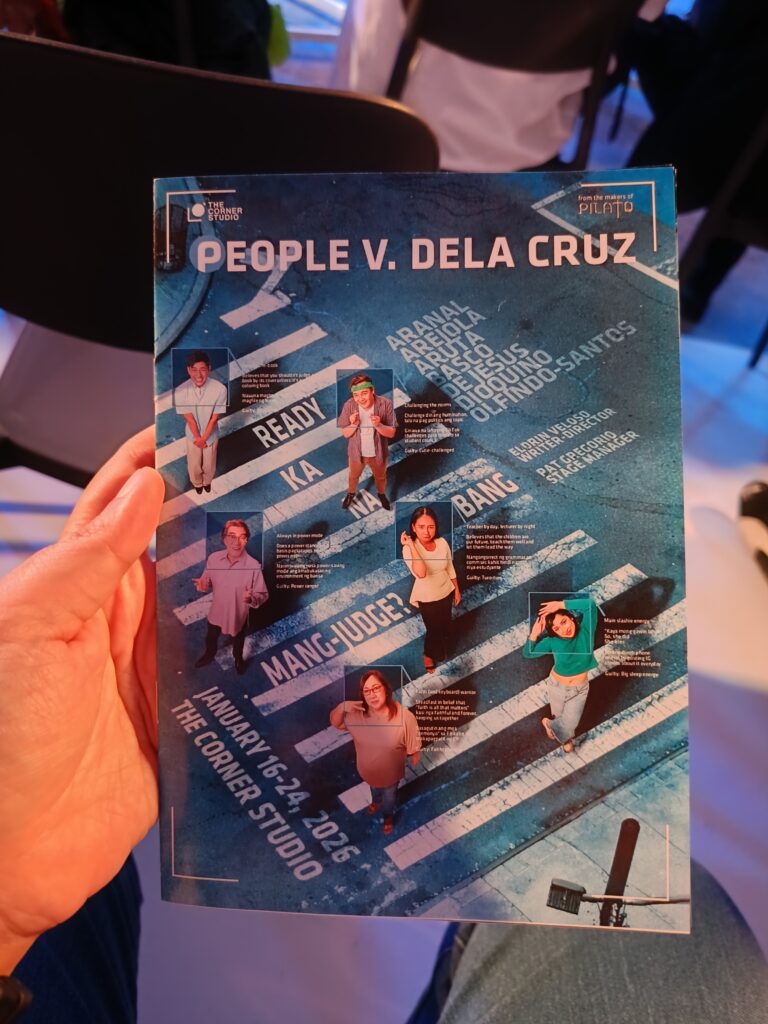
There’s an edgy young man who resists authority. “Lean” (played by Aaron Dioquino) openly challenges beliefs he considers outdated. He questions how fair the law really is. Ordinary people face bigger consequences than those in power.
“Solara” (played by Pauline Arejola) stays mostly quiet and anxious during deliberation. She simply wants the jury to reach a decision so she can go home and avoid the mess.
Mayor Rico (played by Mark Aranal) has already made up his mind. Instead of examining the details, he pushes for a quick resolution. He seemingly wants to protect the system he represents and is aware of the attention the case will bring.
Then, there’s “Orion” (played by JP Basco), a paralegal who presents himself as calm and objective. He often steps in to moderate the discussion. But when tensions rise, it becomes clear that he isn’t as neutral as he first presents himself.
“Marian” (played by Emlyn Olfindo-Santos) is a conservative woman who is deeply set in her beliefs. She makes sense of the case through her faith. Most of her opinions come from what she sees online, and she rarely questions them. The others don’t exactly take her seriously because of it.
“Katniss” (played by Althea Aruta) is a teacher who insists on seeing the accused as a human rather than just a case. She rejects the strict black‑and‑white logic of the law and pays attention to the gray areas the evidence leaves behind.
Then, there’s the marshal (played by Rain de Jesus). She explains how the jury system works at the beginning. Later on, that lightness starts to feel a little off. The play hints she’s hiding something you’re not meant to look at too closely.
Put them all in one room and things fall apart pretty fast. When they get close to something useful, they circle back to the same points again. One step forward, two steps back.
I get why that might be frustrating to watch. The play doesn’t really move toward a clean, conclusive answer.
Sounds familiar, right? It’s like real-life politics, just on a stage with better lighting.
How The Story Unfolds
The play moves at a sharp pace. Once it hooks you, it doesn’t let go.
A lot of that comes from the dialogue. You can tell the writers did their homework. The legal parts are explained clearly: whether there was mens rea or intent to kill, whether what happened could count as self‑defense, and what qualifies as hearsay.
As the discussion goes on, the focus drifts. It circles back to the person on trial, and more specifically, to the label people have already given him. Dela Cruz is an “addict,” to many of them, which already means guilt before the facts even settle.
By the end, you realize it’s not just about the evidence. People hold on to what they already believe, even when the facts are staring them in the face.

My one nitpick is that a few scenes lean too heavily on long monologues. They slow the rhythm and weigh the dialogue down. The comic beats help reset the energy, but they don’t always restore the pacing.
What I appreciated most is that every character gets their moment. Even the quiet or slower ones end up adding something important to the conversation.
The play doesn’t really single anyone out as the villain. Instead, it shows how everyone in the room is flawed in their own way. Each one defines and shapes justice, for better or for worse.
By the end, the audience is treated as the seventh member of the jury. You’re left to sit with the decision yourself. It concludes on a hopeful note, but there’s something ominous underneath it too. You get a sense that a larger system, one that thrives on division, is still at work.
Final Thoughts
Overall, People v. Dela Cruz is an ambitious piece held together by strong writing and solid performances. The play knows exactly what it is and what it isn’t. It never pretends to offer procedural accuracy, because that has never been its goal.
This one-act play has a lot to say about the war on drugs. When violence comes from the police, it is often treated as normal and quickly forgotten. Here, the roles are reversed. A civilian kills an officer, and it becomes urgent, public, and impossible to ignore. For that alone, I believe this play deserves a wider audience.
As I leave the venue, the story stays with me. I still think about the arguments, the people in that room, and what justice is supposed to mean in real life.
Oh my!!!!! This brought me to tears!!!! Thank you for understanding our play and what its message TRULY is!!!! 🥰
Great content! Keep up the good work!